Showing posts with label market. Show all posts

Thursday, October 1, 2015

When Are Investors Most Bullish?

I found this on Stocktwits.com. This shows how investor sentiment (on average) changes both by the hour of the day and during the day of the week.


Stocktwits' conclusion: "investors were most bullish when the market was closed."

Something to keep in mind when you're going to buy, and when you're going to sell.

There's a lot more at the original article.

Monday, July 7, 2014

The Running of the Bulls: Most Wall Street Economists Are Idiots

Today, we see the kick-off of the Running of the Bulls in Pamplona, Spain.

The running of the bulls is when idiots and/or men with something to prove about their manhood run in the streets before a pack of animals that will later be ritualistically tortured to death in an arena. 

Surely, man at his best. And yes, that's sarcasm. I've seen a bullfight in the flesh once -- for I was also a young idiot in my day -- and I don't need to see another.

Meanwhile, Wall Street has its own Running of the Bulls.
The stock market closed last week up 189% since its bottom in 2009.  The S&P 500 index has gained 7.4% for the year so far, building on last year's 30% spike.

Also last week, the Dow pushed through 17,000 -- which any trader will tell you is just a number. Still, it's a big number.

This week, the market is looking to start off with a slump. The reason is economists working at Wall Street banks are moving up their expectations of when the Fed will start hiking interest rates.

And the reason for that is last week's stellar jobs numbers. The Bureau of Labor Statistics showing U.S. employers added 288,000 jobs in June, well above the 215,000 expected by economists. The unemployment rate unexpectedly fell to 6.1%, from 6.3% a month earlier.

Previously, most Wall Street banks hadn't expected the Fed to start raising rates for at least 3 more quarters -- potentially not until 2016. Now, many think the Fed will raise rates sooner and quicker, seeing that jobs are improving so much.

This just shows that most Wall Street economists are idiots. Hey, they missed the jobs growth, didn't they?

U.S. gross domestic product fell at a seasonally adjusted annual rate of 2.9% in the first quarter, the fastest rate of decline since the recession. Most estimates are that GDP is growing at 2% this quarter ... maybe. That's not much. Sure, GDP not a primary indicator for the Fed.  But it has to be worried that weakness will continue.

What's more, while inflation is picking up, the official inflation rate is still just 2.1%. 

Sure, the Fed will probably get behind the curve as inflation increases. You know how to protect yourself from that. The fact is, the Fed doesn't see inflation now, and that's what matters.

Also, just last week, Fed head Janet Yellen signaled that she would keep interest rates lower for longer than most people think possible. Specifically, she said that it would be a bad idea to raise interest rates to fight financial excesses. 

She added: "efforts to promote financial stability through adjustments in interest rates would increase the volatility of inflation and employment.”

So no, Wall Street. Yellen is not taking away the punch bowl any time soon. She doesn't want to be the Fed Chair who killed the recovery. Hell no!

I know -- I KNOW -- that it's been more than 1,000 days since the S&P 500 suffered a correction. Specifically, the S&P 500 hasn't suffered a 10% drop from its recent high level mark since October of 2011. That's a long time. A correction seems due right?

But just because you expect it to happen doesn't mean it will happen right now.

Look at it this way: We have central banks around the world keep pushing easy money. From the U.S. Fed to Japan to Europe - which now has negative interest rates - the money sluices are open.

Now, add in that the U.S. and global economies continue to recover. Chances of a "hard landing" in China are receding in the rear-view mirror. However, the recovery remains weak. As long as it remains weak, the Fed (and other central banks) aren’t likely to tighten their easy-money policies.

Meanwhile, Wall Street isn't "euphoric" about this rally. Indeed, it's still widely hated.  Many big funds are woefully under-invested. That can be juice for the next big leg up. 

So be prepared. The bulls will run. As the guys in Pamplona will tell you, it's best to run with them.

Monday, September 23, 2013

The Case for Pipelines

The market seems confused lately, and not only by the Fed. After rallying hard last week when the Fed announced it was NOT going to taper its $85-billion-per-month quantitative easing program, the market ended the week by giving it all back.  I still think we could see short-term market weakness due to the looming budget battle in Washington. But longer-term -- say, the next 6 months -- I'm more sanguine. I think the US economy and market could do pretty well over that time frame.

So, what to buy?  I'm bullish on US energy production -- I think we haven't seen the top yet, and won't see it in the next six months, anyway. Therefore, those companies that transport oil and gas through pipelines should see increased business.

We are seeing rising nat-gas production from the Marcellus Shale (Haynesville Shale production has fallen, but not enough to matter yet). Natural gas production from the Marcellus is expected to continue growing as infrastructure constraints in the play ease up. Second-quarter results from Cabot, Range, and other Marcellus producers highlighted the issue of backlogged wells – those that have been drilled but are not currently producing, mainly because they lack pipeline connection.

As backlogged wells are connected to pipelines and brought online over the next several months, production growth this year could top even last year's levels.

Meanwhile, US domestic oil production looks like this ...


Put oil and gas production together, and, according to the US Federal Reserve, US oil and gas extraction increased in August by 11.4% from a year earlier to the highest level since the Federal Reserve began reporting data in January 1972 -- more than 40 years ago!

Sure, some of that product will transport by rail, and some by barge. But a lot will transport by pipeline.

The AMLP is a basket of companies including Enterprise Product Partners (EPD), Kinder Morgan Energy Partners (KMP), Magellan Midstream Partners (MMP), Energy Transfer Partners (ETP) and more. You have one guess as to what business these companies are in, and that guess better start with a "P".
The pipes have a meter and they charge for the amount of oil or gas they pass.  While they are in the energy business, their fortunes do not particularly depend on energy prices, because people need oil and gas delivered whether it is expensive or cheap.  In this respect, pipeline MLPs are like utilities.  

And utilities were one of the beneficiaries when Ben Bernanke shocked Wall Street by NOT cutting quantitative easing at at the most recent Fed meeting. 

Side note -- reports that Chairman Bernanke shouted "Who's Your Daddy? I'M your Daddy!" while keeping QE intact have NOT been substantiated.

Anyway, no QE cut means that bond yields go back down, and utilities, which offer yields that compete with bonds, went up rather nicely last week.


Utilities actually saw a poor end to the week, so their rally potential is still questionable.  Still, there's no doubt that with bond yields falling, stocks and funds that pay nice dividends are looking more attractive than before the Fed's announcement on QE.

And that brings me to my next point, which is that the AMLP sports a 5.82% dividend yield. 

Now, let's look at a weekly chart of the AMLP itself ...


You can see that the AMLP rallied sharply last week, much like utilities, and on strong volume, too. It still has to break through resistance, and nothing is certain.  But I think this is a good bullish bet for the next 6 months.

Not everything is rosy. Fund expenses can eat up some of the dividend yield. And your own tax situation will also affect total return. Let's add in the uncertainty of the oil business, which is a boom-and-bust business. Finally, there's the generally confused mood the market finds itself in. This may lead to more short-term weakness in the AMLP. But that's probably a buying opportunity considering the intermediate forces I've mentioned.

Bottom line, investors would consider the AMLP because it is a play on rising US domestic energy production, and all that oil and gas flowing through pipelines.

This is not an official recommendation. You are in charge of your own investing destiny. Do your own due diligence before buying anything. And before you buy, make sure you know at what price you will sell.

Thursday, August 29, 2013

10 Hot Stories and Charts for Thursday

1. In the short run, the market is a voting machine, but in the long run, it is a weighing machine.Dividend yields and earnings growth drive stock returns. And that's the bottom line.

2. India's economic crisis is getting worse. And check out the plunge in India's currency, the Rupee. The words "market panic" are being used more frequently. My take: This has big implications for the world's agriculture, energy and precious metals markets. I'll write more about this another time.

3. Meanwhile, India may buy gold from ordinary citizens and send it to smelters, in a bid to cut down on gold imports. It's an interesting, even off-the-wall plan. But they've tried everything else. Why not?

4. No surprise, but worth reading: How an insular beltway elite makes wars of choice more likely.  And here's a prime example of your "liberal media" right here. Finally, events are moving quickly in Syria, so here's what you need to know. My take: One can hope for a quick and bloodless resolution to the Syrian situation, but one must also be ready for oil to ramp up to $120 if things get really bad. That's the problem -- all this volatility makes investing difficult. Traders, on the other hand, are having a field day.

5. Nice chart: Where the Middle-Class Jobs Are Vanishing the Fastest

More on employment -- the decline in unemployment since the recession is almost entirely due to a contraction in the number of Americans participating in the labor force. Some good charts at that link, including this one:


6. There are now more electric cars than there are gas stations. Or in raw numbers, approximately 120,000 electric cars versus 117,000 gas stations.

7. Q2 GDP Revised up to 2.5%, Weekly Initial Unemployment Claims decline to 331,000
Both of these numbers were better than expected. See also, The Future Is Still Bright.


Interestingly, while 2nd quarter GDP was revised higher, once again state and federal contributions to GDP were revised lower, and both were outright negative. My take: the economy would be doing better except for the drag of REDUCED government spending. That's something to think about. But the only spending the current Congress likes -- apart from their fatcat salaries and benefits -- is war spending. Maybe we'll get some of that soon, eh?

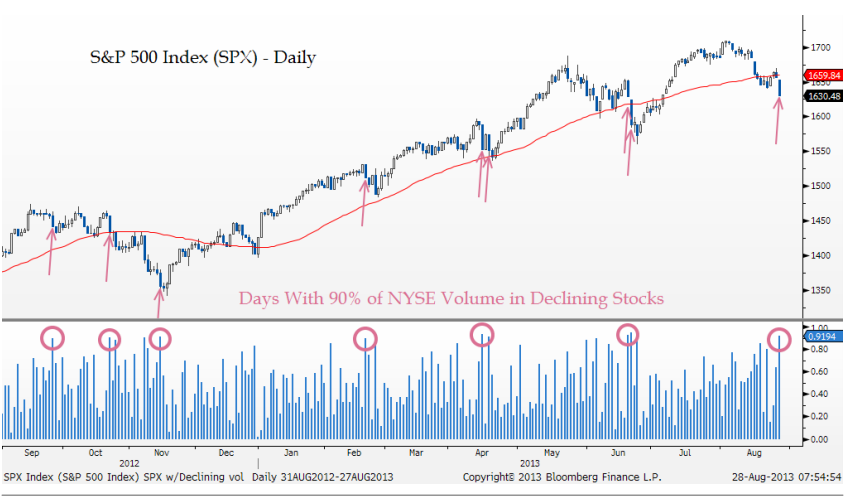
8. Are we close to the end of a correction? The Reformed Broker thinks so. 90% down days (in which 90% or more of volume on the exchange is in declining stocks), which we recently had, tend to come at the end of a correction. He offers this chart, which he picked up from the fine folks at Miller Tabak ...

9. September is a seasonally strong month for gold as jewelers buy ahead of the upcoming major holidays around the world. What's more, while gold has risen 20% since the June low, it also remains well down from the 2011 peak and has only recouped around half of the decline from the high of 2013 to the low. Still, regularity breeds complacency, and if you're complacent in this market, you're a bloody fool.

10. Laugh for the day. For parents everywhere ..

Have a great Thursday. Be careful out there.