Due to an unfortunate mix-up, I spent a good 25 minutes yesterday morning walking up to very large men in the lobby of the Intercontinental Hotel and asking for "Peter."
The fellow I was looking for was described to me as a former football player. But that's the limit of the description, and there are a LOT of big guys in Canada. Luckily, I wasn't arrested on a morals charge.
At least his name wasn't Dick.
"Excuse me, Big Dick? I'm looking for Big Dick!" PUNCH!
Peter apologized by email and called last night to make lunch plans today. Then it accelerated to morning coffee, then "let's just hurry up and film the interview."
On the last day of PDAC, everyone is in a rush.
At least he wanted to be filmed for my Youtube channel. I was told flat-out "no" by multiple people. On a Wednesday morning at PDAC, few feel camera ready. No, they are not ready for their close-ups.
Anyway, Peter turned out to be a former Goldman Sachs banker and a "distressed turnaround specialist." His company has what we in the business call "a wide moat." Peter tells me that a mutual friend of ours, very well known in the biz, likes it. And individual, well-known fund managers have put their own money in it.
Very interesting company. I'll do more research and write this up for subscribers at my new gig at the Weiss Research division, Uncommon Wisdom Daily.
Showing posts with label silver. Show all posts
Showing posts with label silver. Show all posts
Wednesday, March 8, 2017

Thursday, February 4, 2016
What I'm Watching on Gold (And You Should, Too)
The tide in gold seems to have shifted. And I have friends who have already hoisted the Jolly Roger and gone off chasing golden booty already. Apart from some small, longer-term positions, I have not set sail yet. That's because I prefer to trade on weekly closes. And I would like gold (spot) to close above its 200-day moving average.
 (Updated chart)
That said, things have been improving for gold and silver for quite some time. And the U.S. dollar's plunge yesterday was the worst in 7 years. Certainly, that bodes well for gold.
Here are my recent stories on the topics of gold and silver. If you click through, you'll find some suggested picks.
February 3rd
Silver's Secret Countdown
January 27th
The Fear Trade Flourishes
January 16th
A Glimmer of Hope for 2016
Also, I give interviews to the fine folks at HoweStreet.com every other week. Here's the latest. I hesitate to link to it because there is always at least one flaming a-hole in the comments. But I've come to expect that.
It will be an interesting end to the week. Stay tuned.

That said, things have been improving for gold and silver for quite some time. And the U.S. dollar's plunge yesterday was the worst in 7 years. Certainly, that bodes well for gold.
Here are my recent stories on the topics of gold and silver. If you click through, you'll find some suggested picks.
February 3rd
Silver's Secret Countdown
January 27th
The Fear Trade Flourishes
January 16th
A Glimmer of Hope for 2016
Also, I give interviews to the fine folks at HoweStreet.com every other week. Here's the latest. I hesitate to link to it because there is always at least one flaming a-hole in the comments. But I've come to expect that.
It will be an interesting end to the week. Stay tuned.
Wednesday, October 14, 2015
My Recent Articles on Gold, Silver, Oil and More
Monday, February 2, 2015
Important Charts of Silver and Gold
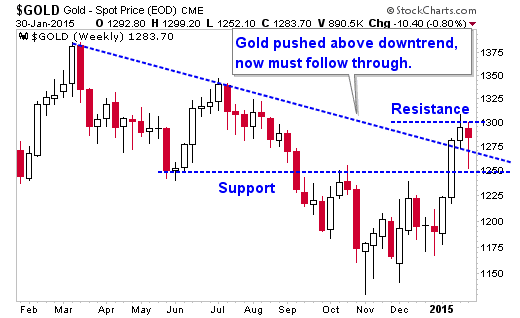
January was not a good months for the broad markets. But Gold just experienced its biggest monthly jump in three years. What comes next?
Here are some weekly charts of silver and gold that I'll be watching. First, gold ...
(Updated chart)
You can see overhead resistance at $1,300 and support at $1,250. Gold pushed above a downtrend. I think things look bullish. A lot depends on the U.S. dollar,which may have peaked the week before last.
Now, let's look at a weekly chart of silver.

(Updated chart)
You can see a similar pattern in silver (no big surprise there. Silver has overhead resistance at $19, and support at $15.
Some precious metals news worth reading ...
Chinese Banks in Talks to Take Part in Gold Fixing Replacement
There’s a “more diverse pool” of participants, including from China, interested in being part of the LBMA Gold Price, Ruth Crowell, chief executive of the London Bullion Market Association, said in a statement Monday.
Will Gold Equities Outperform Gold Bullion This Year?
Frank Holmes offers his latest analysis. One tidbit:
As of Thursday, assets in exchange-traded gold products rose for a tenth session, reaching the highest level since October. Investors added 65.6 metric tonnes so far this month, the most since September 2012. Gold equities, as measured by the NYSE Arca Gold Miners Index, are up 20 percent for January while the S&P 500 Index finished down 3 percent.
Is Gold The New High Yield?
With a rally to start the year, Gold is now up over 6% since the start of 2014 in dollar terms but up 19% in Yen terms and 30% in Euro terms.
The knock on Gold has often been that it “doesn’t yield anything” and that it can be highly volatile. These are valid critiques but today you can say the same thing about the Euro, the Yen, and the Swiss Franc. As long as this is true, the question for investors is which asset is a better safeguard of their wealth: Gold or negative yielding bonds in a rapidly depreciating currency.
Here are some weekly charts of silver and gold that I'll be watching. First, gold ...
(Updated chart)
You can see overhead resistance at $1,300 and support at $1,250. Gold pushed above a downtrend. I think things look bullish. A lot depends on the U.S. dollar,which may have peaked the week before last.
Now, let's look at a weekly chart of silver.
(Updated chart)
You can see a similar pattern in silver (no big surprise there. Silver has overhead resistance at $19, and support at $15.
Some precious metals news worth reading ...
Chinese Banks in Talks to Take Part in Gold Fixing Replacement
There’s a “more diverse pool” of participants, including from China, interested in being part of the LBMA Gold Price, Ruth Crowell, chief executive of the London Bullion Market Association, said in a statement Monday.
Will Gold Equities Outperform Gold Bullion This Year?
Frank Holmes offers his latest analysis. One tidbit:
As of Thursday, assets in exchange-traded gold products rose for a tenth session, reaching the highest level since October. Investors added 65.6 metric tonnes so far this month, the most since September 2012. Gold equities, as measured by the NYSE Arca Gold Miners Index, are up 20 percent for January while the S&P 500 Index finished down 3 percent.
Is Gold The New High Yield?
With a rally to start the year, Gold is now up over 6% since the start of 2014 in dollar terms but up 19% in Yen terms and 30% in Euro terms.
The knock on Gold has often been that it “doesn’t yield anything” and that it can be highly volatile. These are valid critiques but today you can say the same thing about the Euro, the Yen, and the Swiss Franc. As long as this is true, the question for investors is which asset is a better safeguard of their wealth: Gold or negative yielding bonds in a rapidly depreciating currency.
Wednesday, November 5, 2014
Oil War, Gold Down, Silver Down Even More
Some stuff I'm reading today.
U.S. Returns Fire in Saudi Arabia's Oil War
The U.S. may buy crude (for the Strategic Petroleum Reserve) to offset a price collapse caused by Saudi dumping and support U.S. shale producers. It could also go further, tacking on a tax on Saudi oil, an issue that would at some point go before the world trade council.
BHP Signs Deal to Sell $50 Million of Lightly Processed Crude Without Official Permit.
 A major energy company will soon sell U.S. oil abroad without explicit permission from the government, another sign that the decades-old federal ban on crude exports is crumbling.
BHP Billiton’s deal to sell about $50 million of ultralight oil from Texas to foreign buyers without formal government approval is likely to be only the first of many such moves as energy companies seek new markets and higher prices for the surge of crude now pumped in the U.S.
People in the industry said the U.S. Commerce Department, which oversees oil exports, has been encouraging companies to pursue independent exports without having to issue new rulings permitting it, a process being called “self-classification.”
The department didn’t respond to requests for comment. Department officials have maintained that there has been no change to U.S. oil-export policies.
Refiners and other buyers of light oil across Asia are interested in American condensate so they can diversify their supply from the Mideast.
Silver Falls 5% to a New 4.5-Year Low. Gold Breaks Support
Gold sunk below $1,150 per ounce on Wednesday to its lowest since mid-2010, opening the way for a fall to $1,000 as a surging dollar and stronger share prices weaken the investment case for non-yielding bullion.
Silver fell even harder to hit its cheapest since February 2010 at just above $15 an ounce.
No. 1 gold ETF sees biggest monthly outflow this year in October
The world's largest gold-backed exchange-traded fund, New York's SPDR Gold Shares, saw an outflow of over $1 billion of metal last month as investors lightened holdings in anticipation of a further price drop from current four-year lows.
U.S. Returns Fire in Saudi Arabia's Oil War
The U.S. may buy crude (for the Strategic Petroleum Reserve) to offset a price collapse caused by Saudi dumping and support U.S. shale producers. It could also go further, tacking on a tax on Saudi oil, an issue that would at some point go before the world trade council.
BHP Signs Deal to Sell $50 Million of Lightly Processed Crude Without Official Permit.
A major energy company will soon sell U.S. oil abroad without explicit permission from the government, another sign that the decades-old federal ban on crude exports is crumbling.BHP Billiton’s deal to sell about $50 million of ultralight oil from Texas to foreign buyers without formal government approval is likely to be only the first of many such moves as energy companies seek new markets and higher prices for the surge of crude now pumped in the U.S.
People in the industry said the U.S. Commerce Department, which oversees oil exports, has been encouraging companies to pursue independent exports without having to issue new rulings permitting it, a process being called “self-classification.”
The department didn’t respond to requests for comment. Department officials have maintained that there has been no change to U.S. oil-export policies.
Refiners and other buyers of light oil across Asia are interested in American condensate so they can diversify their supply from the Mideast.
Silver Falls 5% to a New 4.5-Year Low. Gold Breaks Support
Gold sunk below $1,150 per ounce on Wednesday to its lowest since mid-2010, opening the way for a fall to $1,000 as a surging dollar and stronger share prices weaken the investment case for non-yielding bullion.
Silver fell even harder to hit its cheapest since February 2010 at just above $15 an ounce.
No. 1 gold ETF sees biggest monthly outflow this year in October
The world's largest gold-backed exchange-traded fund, New York's SPDR Gold Shares, saw an outflow of over $1 billion of metal last month as investors lightened holdings in anticipation of a further price drop from current four-year lows.
Monday, October 20, 2014
Gold Silver Ratio Chart
A sneak peak from my InvestmentU.com column this week.
 (Updated chart)
A few things to keep in mind.
A wise man once said: “The market can remain irrational longer than you can remain solvent.”
And as for long-run averages, the same guy also said: “In the long run, we are all dead.”
That said, history is on a side of a pullback once 80 is reached.
A few things to keep in mind.
A wise man once said: “The market can remain irrational longer than you can remain solvent.”
And as for long-run averages, the same guy also said: “In the long run, we are all dead.”
That said, history is on a side of a pullback once 80 is reached.
Saturday, August 9, 2014
Good Year (So Far) for Gold & Resource Trader
My colleague Matt Carr crunched the numbers on the performance of my publication Gold & Resource Trader (GRT) and came up with some stats to lift my spirits.
On Wednesday, Matt wrote:
Matt added ...
Then Matt said ...
So where does this leave us now? I recommended my GRT subscribers close two more positions on Thursday. One was barely positive, but it was turning against us, and I'll take any win when the broad market was having a terrible day. The other position was yet ANOTHER double-digit percentage gain.
Of course, individual performance depends on where you buy and sell, and what commissions you pay, if any.
Bottom line: it's been a pretty good year so far. Sure, many of GRT’s gains are on the small side. But there are plenty of double-digit percentage gains as well.
If you're one of my paying subscribers, thanks for coming along for the ride.
On Wednesday, Matt wrote:
You had a banner start to the year: out of 20 closed positions (including partial closes), 16 were closed for gains, 3 losses and one flat. And 9 of those closed positions were for double-digit percentage gains.
And all of that was during when the sh*t hit the fan – from mid-January to April – when the broader markets corrected, biotechs collapsed and the Nasdaq toppled.
Matt added ...
The Dow (based on yesterday's close) is up only 0.10% for the year. The S&P is up 4.56%. The Nasdaq is up 4.57%. And the Russell 2000 (small caps) is down 3.06% this year. Gold – for instance, SPDR Gold Shares Trust (GLD) – is up over 5%. Despite all the negative news and views on gold. Metals have outperformed the market this year. Even the lowly gold.
Then Matt said ...
GRT has only closed 8 positions for losses so far in 2014. That’s out of 35 closed positions. That’s a success rate of 77.14% on closed positions… Basically 8 out of 10 positions are closed for gains. Sean’s had 11 positions closed for double-digit gains. And has two more positions open with double-digits gains at the moment. He has a very strong track record. A very strong track record in a sector most investors have abandoned or cast aside.
Of course, individual performance depends on where you buy and sell, and what commissions you pay, if any.
Bottom line: it's been a pretty good year so far. Sure, many of GRT’s gains are on the small side. But there are plenty of double-digit percentage gains as well.
If you're one of my paying subscribers, thanks for coming along for the ride.
All the best,
Sean
Thursday, August 7, 2014
2 Precious-Metal Must-Sees
Do you believe in cycles? Many people use them in trading. I think gold is in a virtuous cycle now, and that's partly why I think it's going to $1,430 by the end of next month.
And for those who cringe about making predictions: Remember the phrase, "strong convictions, loosely held." In other words, nothing is set in stone.
Meanwhile, I don't follow any particular silver cycles. Silver is gold on steroids, right? It will just over-do whatever move gold makes. So who cares about silver cycles?
Well, one guy cares, and he is watching a 36-month silver cycle.

That's from @Gann360, a technical analyst I follow on Twitter.
Does it mean anything? I don't know. It is interesting to look at, though.
Now, that's one thing. The other thing is that the great folks at Visual Capitalist have put together one of their nifty infographics (again). This one is about "What the IRS needs to know when you buy and sell gold & silver".
 You can see this in full-size glory at http://www.visualcapitalist.com/precious-metals-irs-needs-know/
And for those who cringe about making predictions: Remember the phrase, "strong convictions, loosely held." In other words, nothing is set in stone.
Meanwhile, I don't follow any particular silver cycles. Silver is gold on steroids, right? It will just over-do whatever move gold makes. So who cares about silver cycles?
Well, one guy cares, and he is watching a 36-month silver cycle.
That's from @Gann360, a technical analyst I follow on Twitter.
Does it mean anything? I don't know. It is interesting to look at, though.
Now, that's one thing. The other thing is that the great folks at Visual Capitalist have put together one of their nifty infographics (again). This one is about "What the IRS needs to know when you buy and sell gold & silver".
Wednesday, July 16, 2014
Gold, Silver and Thor!
Quote for the Day
"Only the mediocre are always at their best." — Jean Giraudoux
My Latest Article on Gold
Gold's Sell-Off: Should You Buy It?
Some folks are asking: Is the gold bull run over? Is it time to sell?
The answer is, “It depends on what kind of time frame you have.” If your only time frame is short term, sure, sell. If your time frame is anything but short term, this pullback should be a great buying opportunity in both gold and silver. I’ll show you why, and where you might consider picking up gold or gold mining stocks again.
Read the rest HERE.
My Latest Article on Silver
Why You Should Invest in Silver Now
The big banks have smashed gold and silver lower this week, and after that shellacking, you'd have to be crazy to buy precious metals, right?
Yeah. Crazy like a fox.
If you're smart, you're going to put on your big-boy pants and buy silver right now.
Here's a chart from the story.

Read the rest of the story HERE.
My View on Marvel's Announcement that Thor Is Now a Woman

See the announcement HERE.
My view: This is a bad idea. A) it's lazy and B) it shows disrespect for the fans.
Here me out before you think I'm a raging sexist.
First, I know why Marvel is doing this rather than launching a new female character. It is tough to generate the same level of interest/buy-in for a brand-new character than for an already-popular one.
However, that said, LAZY! Thor's defining characteristic is his masculinity. Taking a character that is masculine at his core and recasting as a female simply to generate an audience from the get-go is just plain lazy.
Now, as for disrespecting the fans: The fans can take something new. Hell, they're eager for something new IF IT IS DONE WELL.
If Marvel wants to stick with Norse mythology, there are plenty of Norse Goddesses to choose from. Loki in the Norse mythology has a daughter named Hel. She is the goddess of the dead. Interesting mythological factoid: "Although the gods looked upon her with loathing, Hel had more power than Odin." Ah, so hated AND powerful. Can you see the story possibilities there?
Or take Loki -- Loki changes sexes, so there's no problem playing Loki as a woman. Or a transgendered woman if they wanted to go that route. Hell, Loki even turned into a female horse and gave birth, though I don't expect Marvel to go that far.
And Loki has all sorts of conflicts, good/bad stuff going on, including a sibling rivalry with Thor, that makes a female Loki perfect for a modern-age character. Loki IS chaos, and will help you or hurt you depending on her mood and/or the situation. Loki does come through in the clutch a number of times.
CONCLUSION: The much smarter move would be to recast Loki as female, and use all the potential that hasn't been explored in that character.
"Only the mediocre are always at their best." — Jean Giraudoux
My Latest Article on Gold
Gold's Sell-Off: Should You Buy It?
Some folks are asking: Is the gold bull run over? Is it time to sell?
The answer is, “It depends on what kind of time frame you have.” If your only time frame is short term, sure, sell. If your time frame is anything but short term, this pullback should be a great buying opportunity in both gold and silver. I’ll show you why, and where you might consider picking up gold or gold mining stocks again.
Read the rest HERE.
My Latest Article on Silver
Why You Should Invest in Silver Now
The big banks have smashed gold and silver lower this week, and after that shellacking, you'd have to be crazy to buy precious metals, right?
Yeah. Crazy like a fox.
If you're smart, you're going to put on your big-boy pants and buy silver right now.
Here's a chart from the story.
Read the rest of the story HERE.
My View on Marvel's Announcement that Thor Is Now a Woman
See the announcement HERE.
My view: This is a bad idea. A) it's lazy and B) it shows disrespect for the fans.
Here me out before you think I'm a raging sexist.
First, I know why Marvel is doing this rather than launching a new female character. It is tough to generate the same level of interest/buy-in for a brand-new character than for an already-popular one.
However, that said, LAZY! Thor's defining characteristic is his masculinity. Taking a character that is masculine at his core and recasting as a female simply to generate an audience from the get-go is just plain lazy.
Now, as for disrespecting the fans: The fans can take something new. Hell, they're eager for something new IF IT IS DONE WELL.
If Marvel wants to stick with Norse mythology, there are plenty of Norse Goddesses to choose from. Loki in the Norse mythology has a daughter named Hel. She is the goddess of the dead. Interesting mythological factoid: "Although the gods looked upon her with loathing, Hel had more power than Odin." Ah, so hated AND powerful. Can you see the story possibilities there?
Or take Loki -- Loki changes sexes, so there's no problem playing Loki as a woman. Or a transgendered woman if they wanted to go that route. Hell, Loki even turned into a female horse and gave birth, though I don't expect Marvel to go that far.
And Loki has all sorts of conflicts, good/bad stuff going on, including a sibling rivalry with Thor, that makes a female Loki perfect for a modern-age character. Loki IS chaos, and will help you or hurt you depending on her mood and/or the situation. Loki does come through in the clutch a number of times.
CONCLUSION: The much smarter move would be to recast Loki as female, and use all the potential that hasn't been explored in that character.
Friday, July 11, 2014
Bearish Day for Precious Metals Producers Is an Opportunity
Many of the precious metals producers I follow had bearish outside reversals on Thursday. Silver Wheaton (SLW) is an example ...

This pullback has some short-term consequences. For Silver Wheaton, we could see a pullback to support at 24.75 or 23.85. But if you're a longer-term investor, look on the bright side. You probably didn't buy as much gold and silver miners as you wish you did before the recent run-up. Now you'll get your chance to buy before the NEXT run-up.
But do you have the big brass ones to buy this pullback? Here's where we separate the men from the boys.
Update: My Own Market Narrative offers more analysis on the recent action in gold miners and pullback potentialities.
But do you have the big brass ones to buy this pullback? Here's where we separate the men from the boys.
Update: My Own Market Narrative offers more analysis on the recent action in gold miners and pullback potentialities.
Tuesday, July 8, 2014

Saturday, June 21, 2014
Could Gold Keep Rallying? If So, How Far? CHART
The past two weeks have been quite good for gold. And last week, short-term momentum shifted to the bulls, and on higher-than-usual volume, too.
 (Updated chart)
The set-up is a potential inverse head-and-shoulders pattern. RSI is a short-term momentum indicator, on the bottom of the chart. It just gave a "buy" signal this past week.
If, down the road, the inverse H&S pattern works out, this gives us a target of $1,600 on gold.
That's longer-term. Short-term, I think that we'll see gold continue to rally. I think we're going to see a test of the "neckline" of this potential inverse head-and-shoulders pattern.
Now, in Gold & Resource Trader, we've been adding positions to ride this train (in Oxford Resource Explorer, my monthly newsletter, we already held positions, as that service doesn't trade as often or as quickly). The new GRT positions are working out fine. Better than fine.
Are you too late to this gravy train? I don't think so.
The next gold futures settlement is on June 26th. We usually see gold futures sell off into the settlement (you can insert your own joke about market manipulation here) because the market makers don't want to pay off on the bullish gold call options they've been writing.
So, if we get that pullback, that should suck some wind out of gold miners. And that would be a great time to buy, if you dare.
By the way, silver is outperforming gold in this rally, as it usually does. And silver miners are on fire.
This will not be a straight-up move. And the big question is what happens around that $1,400 area. I recently gave my subscribers a long list of fundamental reasons why I think gold and silver will keep rallying for the next five to six months. Your reasons, bullish or bearish, will be your own.
Good luck, and good trades
Sean
The set-up is a potential inverse head-and-shoulders pattern. RSI is a short-term momentum indicator, on the bottom of the chart. It just gave a "buy" signal this past week.
If, down the road, the inverse H&S pattern works out, this gives us a target of $1,600 on gold.
That's longer-term. Short-term, I think that we'll see gold continue to rally. I think we're going to see a test of the "neckline" of this potential inverse head-and-shoulders pattern.
Now, in Gold & Resource Trader, we've been adding positions to ride this train (in Oxford Resource Explorer, my monthly newsletter, we already held positions, as that service doesn't trade as often or as quickly). The new GRT positions are working out fine. Better than fine.
Are you too late to this gravy train? I don't think so.
The next gold futures settlement is on June 26th. We usually see gold futures sell off into the settlement (you can insert your own joke about market manipulation here) because the market makers don't want to pay off on the bullish gold call options they've been writing.
So, if we get that pullback, that should suck some wind out of gold miners. And that would be a great time to buy, if you dare.
By the way, silver is outperforming gold in this rally, as it usually does. And silver miners are on fire.
This will not be a straight-up move. And the big question is what happens around that $1,400 area. I recently gave my subscribers a long list of fundamental reasons why I think gold and silver will keep rallying for the next five to six months. Your reasons, bullish or bearish, will be your own.
Good luck, and good trades
Sean
Friday, April 18, 2014
6 Hot Stories & Charts on Gold & Silver
As we slide into a Good Friday weekend, I have some charts of gold and silver for you.
Let's start with two factoids from Frank Holmes at US Global ...
#1: China Continues to Accumulate Gold

China is now thought to hold 2,716 tonnes of gold, while the U.S. holds 8,812 tonnes. China would still need ten years for its gold holdings to catch up to the U.S., suggesting strong gold demand from China. With Russia on the offensive again, it too has the capacity to push oil prices higher, boost its revenue and purchase additional gold beyond domestic production.
XX Update -- thanks to sharp-eyed reader "Anonymous," I have corrected this figure. US Global listed it as "million tonnes," and I didn't catch it. The World Gold Council lists more likely numbers. The chart is still wrong.
#2. India's Gold Trade Caught in Cash Bind.
India’s general election has negatively impacted gold trade in the country. Gold traders in India are used to cash transactions when buying and selling gold. With the election code of conduct in force, traders face severe restrictions on carrying physical cash in large denominations. According to Hasmukh Bafna, President of the Gold Chains & Jewellery Welfare Association, business has dropped by 70 to 80 percent since the first week in March.This low gold demand is expected to continue until the middle of May
#3. Russia Rising.
Russia has now overtaken the U.S. to become the world’s second-largest gold producer behind China. In fact, the Wall Street Journal reports that Russia's production of gold-containing concentrates increased in January-March by 12.3% compared with January-March 2013, and the country's gold output increased by 32.6% on the year.
#4. Silver Production at Primary Producers on a Slippery Slope
Steve at SRSRoccoReports.com says that for 2013, the top primary silver miners suffered the lowest average silver yield ever.

Read the rest of his analysis HERE.
#5. Gold Miner All-In Cost Blues
Deutsche Bank has released a chart showing all-in costs of some smaller gold producers.
 Chart found HERE.
#6. Chart of Gold
Finally, here's an updated version of my gold chart.

(Updated chart)
Clearly, this was a bearish week for the metal. Gold closed below $1,300 AND its 200-day moving average. A test of support seems likely.
I'm sorry if that's not bullish enough for you. If you want bullish, look at natural gas. I'll have more analysis on that next week.
Have a happy Good Friday and a Wonderful Easter. By the way, do you wonder why it's called "Good" Friday. Wonder no more.
Peace be upon you.
Let's start with two factoids from Frank Holmes at US Global ...
#1: China Continues to Accumulate Gold
China is now thought to hold 2,716 tonnes of gold, while the U.S. holds 8,812 tonnes. China would still need ten years for its gold holdings to catch up to the U.S., suggesting strong gold demand from China. With Russia on the offensive again, it too has the capacity to push oil prices higher, boost its revenue and purchase additional gold beyond domestic production.
XX Update -- thanks to sharp-eyed reader "Anonymous," I have corrected this figure. US Global listed it as "million tonnes," and I didn't catch it. The World Gold Council lists more likely numbers. The chart is still wrong.
#2. India's Gold Trade Caught in Cash Bind.
India’s general election has negatively impacted gold trade in the country. Gold traders in India are used to cash transactions when buying and selling gold. With the election code of conduct in force, traders face severe restrictions on carrying physical cash in large denominations. According to Hasmukh Bafna, President of the Gold Chains & Jewellery Welfare Association, business has dropped by 70 to 80 percent since the first week in March.This low gold demand is expected to continue until the middle of May
#3. Russia Rising.
Russia has now overtaken the U.S. to become the world’s second-largest gold producer behind China. In fact, the Wall Street Journal reports that Russia's production of gold-containing concentrates increased in January-March by 12.3% compared with January-March 2013, and the country's gold output increased by 32.6% on the year.
#4. Silver Production at Primary Producers on a Slippery Slope
Steve at SRSRoccoReports.com says that for 2013, the top primary silver miners suffered the lowest average silver yield ever.
Read the rest of his analysis HERE.
#5. Gold Miner All-In Cost Blues
Deutsche Bank has released a chart showing all-in costs of some smaller gold producers.
#6. Chart of Gold
Finally, here's an updated version of my gold chart.
(Updated chart)
Clearly, this was a bearish week for the metal. Gold closed below $1,300 AND its 200-day moving average. A test of support seems likely.
I'm sorry if that's not bullish enough for you. If you want bullish, look at natural gas. I'll have more analysis on that next week.
Have a happy Good Friday and a Wonderful Easter. By the way, do you wonder why it's called "Good" Friday. Wonder no more.
Peace be upon you.
Tuesday, February 18, 2014
CanGold Interview -- Developing a Gold/Silver Project in Mexico
Here's an interview I did last week with Erick Bertsch of CanGold (CLD on the TSX-V) ...
As I state in the video, CanGold is a very small company (market cap of just C$3.9 million). It has a lot of potential (in my opinion), but if you're interested, do your own due diligence. This is not an official Oxford Club recommendation.
As I state in the video, CanGold is a very small company (market cap of just C$3.9 million). It has a lot of potential (in my opinion), but if you're interested, do your own due diligence. This is not an official Oxford Club recommendation.
Friday, February 14, 2014
Silver Breaks Out -- Here Are Your Targets
Silver is breaking out to the upside, after 11 weeks of consolidation in a rectangle bottom. The main mover for both silver and gold -- which is also up strongly today -- is Chinese trade data.
I've been saying for some time that the center of gravity for precious metals has moved from West to East. What happens in China is much more important for both gold and silver nowadays than what happens in New York.
Here, I've created a daily chart of the iShares Silver Trust (SLV) with a "volume by price" overlay to give you some targets ...
 (Updated chart)
That little smudge on the far right side that I've put a yellow circle around -- that's silver's price action today. Since it is breaking out, we might expect it to keep rallying until people start to sell it (duh). And that's more likely to happen at levels where more of it was bought or sold. Volume by price -- the gray/pink bars going across the chart -- show us just that.
So the next overhead resistance comes at 21.50. That's where a lot of silver was bought, but even more was sold. aFter that comes 22.55. And after that, we'll see if silver can get over its previous two highs, just under $24.
What if silver gets above $24? Then I'd really only look to the technical level of the low silver made at 25.17 before it collapsed.
Above that, the next place where silver saw a lot of buying and selling was around $30.40.
You could choose other support and resistance for silver using, say, Fibonacci levels. I'm just using this chart to present some ideas. In any case, silver looks pretty bullish from a technical standpoint.
Reuters reports: The value of China's total exports climbed 10.6 percent in January from a year earlier, the Customs Administration said on Wednesday, more than five times market forecasts for a 2 percent rise.That was a couple days ago. But silver is starting to get good press. And apparently that jolted the sleeping giant that is Wall Street into action today.
I've been saying for some time that the center of gravity for precious metals has moved from West to East. What happens in China is much more important for both gold and silver nowadays than what happens in New York.
Here, I've created a daily chart of the iShares Silver Trust (SLV) with a "volume by price" overlay to give you some targets ...
That little smudge on the far right side that I've put a yellow circle around -- that's silver's price action today. Since it is breaking out, we might expect it to keep rallying until people start to sell it (duh). And that's more likely to happen at levels where more of it was bought or sold. Volume by price -- the gray/pink bars going across the chart -- show us just that.
So the next overhead resistance comes at 21.50. That's where a lot of silver was bought, but even more was sold. aFter that comes 22.55. And after that, we'll see if silver can get over its previous two highs, just under $24.
What if silver gets above $24? Then I'd really only look to the technical level of the low silver made at 25.17 before it collapsed.
Above that, the next place where silver saw a lot of buying and selling was around $30.40.
You could choose other support and resistance for silver using, say, Fibonacci levels. I'm just using this chart to present some ideas. In any case, silver looks pretty bullish from a technical standpoint.
Friday, February 7, 2014
3 Online Silver Sellers
One of my Twitter friends (hi, @furlicity) asked me where she could buy silver coins online. I can't give that kind of individual advice. But what I CAN do is blog about where I've bought coins successfully in the past.Click on the title/links to go to the website.
1. APMEX
I've bought from APMEX online multiple times. When all is said and done -- shipping, handling, etc., APMEX usually has a great deal. And they have no problem taking my credit card. You can call them toll free at 800.375.9006, and they have a live-chat function on their website that I've found useful.
2. Gainesville Coin
This website has interesting deals sometimes. I remember I had to jump through some hoops to buy from them online the first time. However, I live in Florida, and this company has a nice showroom at 17860 N. US Hwy 41 Lutz, Florida. There's nothing better than buying face-to-face. You can email Gainesville Coin at sales@gainesvillecoins.com for more info, or call 813.482.9300.
3. Great Panther Silver Rounds and First Majestic Silver Rounds
I've bought from these two silver producers in the past. Now for me, it's kind of neat to have a coin
 from a mine I've been to visit. And the fact is, these companies make downright beautiful coins. And there is something cool for anyone to know that your silver came from a particular mine.
That said, I remember these coins were a bit more pricey than coins you might buy at APMEX. Still, if you think silver is going to $50, what's a few pennies difference now?
First Majestic also offers silver ingots and bars as well. You can contact First Majestic about buying bullion at
service@firstmajestic.com
And Great Panther's general contact email is info@greatpanther.com
Now, before you go emptying your wallets, a disclaimer: These are not endorsements of these or any particular gold or silver sellers. There are other fine silver sellers, but these are four that I've bought from. Your personal experience may not be as smooth as mine. And always, ALWAYS make sure you are clear on shipping charges, insurance, etc. before you buy.
Finally, you'll notice that I am not listing eBay as a place to buy silver coins. There's a reason for that. If you're going to buy coins on eBay, just go give your money to charity instead.
I'll write about online gold dealers, and other online silver dealers, another day.
1. APMEX
I've bought from APMEX online multiple times. When all is said and done -- shipping, handling, etc., APMEX usually has a great deal. And they have no problem taking my credit card. You can call them toll free at 800.375.9006, and they have a live-chat function on their website that I've found useful.
2. Gainesville Coin
This website has interesting deals sometimes. I remember I had to jump through some hoops to buy from them online the first time. However, I live in Florida, and this company has a nice showroom at 17860 N. US Hwy 41 Lutz, Florida. There's nothing better than buying face-to-face. You can email Gainesville Coin at sales@gainesvillecoins.com for more info, or call 813.482.9300.
3. Great Panther Silver Rounds and First Majestic Silver Rounds
I've bought from these two silver producers in the past. Now for me, it's kind of neat to have a coin
That said, I remember these coins were a bit more pricey than coins you might buy at APMEX. Still, if you think silver is going to $50, what's a few pennies difference now?
First Majestic also offers silver ingots and bars as well. You can contact First Majestic about buying bullion at
service@firstmajestic.com
And Great Panther's general contact email is info@greatpanther.com
Now, before you go emptying your wallets, a disclaimer: These are not endorsements of these or any particular gold or silver sellers. There are other fine silver sellers, but these are four that I've bought from. Your personal experience may not be as smooth as mine. And always, ALWAYS make sure you are clear on shipping charges, insurance, etc. before you buy.
Finally, you'll notice that I am not listing eBay as a place to buy silver coins. There's a reason for that. If you're going to buy coins on eBay, just go give your money to charity instead.
I'll write about online gold dealers, and other online silver dealers, another day.
Wednesday, January 15, 2014
Top 10 Reads on Gold and Silver -- the best values in decades!
US Silver Eagle Sales Start 2014 Off With a Bang!
1. The US Mint started its 2014 silver sales on Monday, with
a weekly allocation of American Eagle silver bullion coins of 3.575 million
coins. Between Monday and Tuesday’s sales, 203,500 are left, the
Mint said.
2. No surprise, then, that the premium charged by wholesale
dealers for American Eagle coins from the U.S. Mint may
rise to 17% from 14%, according to Frank McGhee, the head dealer at
Integrated Brokerage Services LLC in Chicago. NOTE: One source says this initial flurry of orders for eagles is no big deal, and and premiums should calm down soon.
3. Sales of American Eagle gold coins by the mint have
reached 63,000
ounces this month. That topped 56,000 ounces sold in all of December.
4. “We expect China to import around 1,200 metric tonnes of
gold in 2014,” says
Standard Bank.
5. India’s Economic Affairs Secretary Arvind Mayaram
announced that the restrictions
on gold imports are likely to continue until at least the end of March,
unless a significant improvement takes place with regard to the nation’s
current account deficit. Keep flogging that dead horse, dummy.
6. Holdings of the world’s largest gold ETF – SPDR Gold
Shares (NYSE:GLD) – dropped more than 3 metric tonnes on Tuesday and outflows
for the year total 8.7 tonnes. At 789.6 tonnes GLD holdings are at the
lowest level since January 2009 after a whopping 552 tonnes left the fund last
year.
7. The consensus
among Wall Street analysts is that the price of gold will fall another
14.5% in 2014 from the average price of the metal in 2013 ($1,413 per ounce).


8. Frank Holmes reports that valuations of gold miners are
approaching their cheapest relative to book value in
at least two decades, precisely at the time when free cash flow generation
has bottomed and cost reductions are kicking in.
9. Here’s an excellent chart on gold miners from the
Financial Times.

And you can read the story that goes with the chart HERE.
10. To get a
sense for the relative value of gold miners and bullion, John Llodra,
partner at New Harbor Financial Group, compares the price of the Philadelphia
Gold and Silver miner index to the spot price of gold. The miner index is at 85
while gold bullion is at $1,226 an ounce -- a ratio 0f 0.07. Over the last 30
years, the ratio was typically just above 0.2.
Even if price of the metal falls another 50%, miners would still be
attractive, says Llodra.
Thursday, January 2, 2014
Interview with Coeur Mining
Here's the second video I shot in San Francisco at the 49 North Resource Investment Conference. You can find the first video HERE. This one is an interview with Bridget Freas, a representative from Couer Mining (Symbol CDE on the NYSE).
I think this Couer interview is especially relevant because the positive action in gold and silver earlier this week may spark new investor interest in mining companies. Couer recently traded at just 0.48 times book value. It's being priced for oblivion. Do you think that's accurate, or is the market mispricing this one?
An important note: During the three months ending on Sep. 30, the company's total production cost of silver per ounce stood at $21.92. In addition, the total production cost per ounce of gold sold stood at $1,614 for the period. That's why Ms. Freas emphasizing cost controls so much. Until the company shows otherwise, we have to assume it's producing gold and silver at a loss. However, we also know that bringing down costs is Couer's main focus right now.
One thing Ms. Freas doesn't mention in this video is that Couer should have a new resource estimate coming out fairly soon. That kind of news has NOT been a catalyst for mining stock prices recently. If a new resource estimate DOES move Couer's share price, that would be very interesting indeed.
Remember, just because I'm posting the interview, this is not an immediate endorsement. Do your own due diligence, and know what price you'll sell a stock at before you buy it.
I think this Couer interview is especially relevant because the positive action in gold and silver earlier this week may spark new investor interest in mining companies. Couer recently traded at just 0.48 times book value. It's being priced for oblivion. Do you think that's accurate, or is the market mispricing this one?
An important note: During the three months ending on Sep. 30, the company's total production cost of silver per ounce stood at $21.92. In addition, the total production cost per ounce of gold sold stood at $1,614 for the period. That's why Ms. Freas emphasizing cost controls so much. Until the company shows otherwise, we have to assume it's producing gold and silver at a loss. However, we also know that bringing down costs is Couer's main focus right now.
One thing Ms. Freas doesn't mention in this video is that Couer should have a new resource estimate coming out fairly soon. That kind of news has NOT been a catalyst for mining stock prices recently. If a new resource estimate DOES move Couer's share price, that would be very interesting indeed.
Remember, just because I'm posting the interview, this is not an immediate endorsement. Do your own due diligence, and know what price you'll sell a stock at before you buy it.
Saturday, November 9, 2013
Invest Like a Pirate. Arrrgh!
Here's some weekend reading for you ...
My family loves the Pirate of the Caribbean movies, and pirates in general. We live in Florida, which doesn't have areas named "The Gold Coast" and the Treasure Coast" for nothing.
What I really find interesting is the economics of piracy, I’m talking about more than “pirate gold” — namely, the four S’s — silver, smuggling, sugar and slaves.
I think natural resource investors can learn a lot from the pirates. I’ll give you the specific lessons in a moment. First, I want to explain how all of these factors contributed to the rise of an entire pirate economy …
Silver and Smuggling:
Taking a Shine to Pieces of Eight
Spain's rush for silver in the new world had some serious blowback. It made a lot of people greedy and jealous. And some of those people were pirates.
But can you blame them? The gold and silver of the new world were making the Spanish filthy rich!
The yield from Mexico’s mines doubled the world supply of silver in less than two centuries.
By the 1700s, Mexico’s silver mines were producing nine million troy ounces of silver each year.
If you include production from Bolivia and Peru, from 1530 to 1800, approximately $6 billion to $8 billion worth of gold and silver were mined in the Spanish American colonies.
You can see why Spain quickly became the wealthiest state in Christendom. However, the country was so beggared by its corrupt, war-mongering rulers that it couldn’t afford to defend its vast holdings in the New World.
That had “opportunity” written all over it for French, English, and Dutch pirates. They swarmed the Spanish treasure ships like fleas on a bunch of slow, ungainly dogs.
What really enraged the Spanish was that the pirates did this with varying levels of complicity from their governments. Heck, Henry Morgan was such a successful privateer and pirate that the English Crown knighted him and appointed him governor of Jamaica.
Why were the other European powers so friendly to pirates? Because they were left empty-handed after the Pope gave the Caribbean and most of South America to the Spanish in the Treaty of Tordesillas (1493).
See, in the 16th Century, the Spanish “owned” South America and the Caribbean. To keep out the riff-raff (English, French and Dutch), they passed laws allowing only Spanish merchants to trade with Spanish colonies in the Americas.
Big mistake! The Spanish merchants fleeced the colonists. So, the colonists found it much better to do business on the French island of Tortuga, England’s base on Barbados, and the Dutch island of Curacao.
Meanwhile, the Spanish did have one busy port — Trinidad. But the governor there had a laughably small garrison and no fortifications. Not being a fool, he took bribes and looked the other way as French, English and Dutch smugglers did a rip-roaring business. So Trinidad also became a base for smugglers and pirates.
Every now and then peace would break out and ruin business for pirates, privateers and smugglers. But it never lasted long. And the smugglers really hit paydirt in the mid-1600s when the British Crown decreed that English colonial goods be carried only in English ships and limited trade between the English colonies and foreigners.
These laws were aimed at ruining those uppity Dutch merchants who depended on free trade. But they amounted to a windfall for smugglers.
There’s little doubt that silver and smuggling helped establish the economies of the Caribbean colonies. But Spanish silver eventually became a back-story to a much bigger commodity …
A Bittersweet Tale of
Sugar and Slavery
Sugar was so important that Columbus brought sugar cane with him on his voyage to the New World. And when the gold ran out, colonists focused on producing lots of it. By 1540, there were several large sugar plantations in Hispaniola.
Unfortunately, sugar and slavery went hand in hand. Starting in 1512, slaves were brought over to work the land. Why bring slaves all the way from Africa? Because in their rush for precious metals, the Spanish worked the natives to death (diseases played a big part, too).
As Europe’s appetite for sugar grew and grew, sugar became the white gold of the Caribbean. Along with rum (made from sugar), tobacco, chocolate, and lumber, sugar was the foundation of the “golden triangle” of trade.
These were the goods that pirates were more than likely to pillage. After all, the silver fleet only sailed once a year. But an industrious pirate could make money on slaves, sugar, tobacco and manufactured goods all year long!
All the while, the European powers battled over prime sugar-growing islands. For example, the Dutch sugar island of Saint Eustatius changed ownership 10 times between 1664 and 1674 as the English and Dutch slugged it out! And guess who the European powers hired to do their dirty work in these constant battles? You get one guess, and I’ll spot you the letter “P.”
It’s fair to say that the late 1600s and early 1700s constituted a “Golden Age of Piracy.” Spanish silver production surged. Slaves were shipped by the ton. The European hunger for sugar approached a mania. And constant warfare between the European powers provided plenty of opportunities to pick up government work both preying on enemy ships and guarding colonies.
The salad days of pirates only came to an end when Britain won decisive victories at sea. That freed up the country’s navy to clear the scum from waves. After 1720, pirates were rounded up, sworn to live by the law or hanged. And this is the period we see portrayed in the Pirates of the Caribbean — when the world is changing and pirates like Jack Sparrow and Barbossa are trying to stay one step ahead of the hangman’s noose.
With the age of steam, the golden age of piracy sailed into the sunset. However, the period has left behind quite a legacy that continues to capture our imaginations today. And, for investors, there are some great lessons to be learned …
Five Pirate Tips for Sailing Through
Today’s Tricky Financial Waters
First, precious metals never go out of style. Gold and silver are great investments today, just as they were in Henry Morgan’s day. That’s because they continue to have real value.
Other metals can have their day in the sun. For example, I believe palladium demand will ramp up with demand for new cars -- and there are already expectations of a supply/demand gap in that metal.
But it's not just metals. Oil is a hot commodity, as the rest of the world wants to drive like Americans. Sure, America is producing a lot more oil. That has weighed on prices. But there are still companies that can make a killing worthy of a pirate king.
Second, it’s best to become an early investor. The first pirate to attack a Spanish treasure fleet was Jean Fleury, a privateer sanctioned by the King of France. In 1521, he bagged two lumbering treasure ships off the Azores. In those early days, nobody was expecting piracy in the middle of the Atlantic, so the treasure ships only had a few cannons and no chance against a heavily armed and determined pirate.
Here’s just part of what Jean bagged: 680 pounds of pearls, 500 pounds of gold dust, 150,000 ducats, three cases of gold bars, and five cases of silver bars!
Jean became a hero in France, and he was quite wealthy. But his major investor, the Viscount of Dieppe, took an even bigger share of the loot because of his foresight … and he never even had to get his feet wet.
Third, think big and long-term. By the time Henry Morgan came along, pirating was already a booming business. So he didn’t have the first-in advantage of Jean Fleury. But by 1661, young Morgan was a captain in his own right and proving himself as a master of battle tactics.
He rode the waves of on-again, off-again wars between England and Spain to military success and wealth. Other pirates captured ships; Morgan captured whole cities — Gran Canada, Portobello, Maracaibo, even Panama City, which was the biggest, richest city in the New World at the time.
Here’s the point for investors: Even if you find out about an investing trend after a lot of the easy money is made, you can still make big money with good timing and a long-term view!
Fourth, good management is critical to an endeavor’s success. England’s Queen Elizabeth I, or Queen Bess, had kind of a “thing” for pirates. Although it didn’t start with Sir Francis Drake, he was one of her favorites. He also happened to be brilliant, thoughtful and cool under fire … the perfect combination to make him a terror on both sea and land.
Drake also didn’t give up in the face of adversity. When his scheme to attack the city of Nombre de Dios on the Isthmus of Panama blew up in his face, he had his crew lay low for four months. Then, when their wounds were healed, they ambushed a gold-laden mule train. Nobody expected a pirate to attack a mule train!
Drake bagged 200 mules carrying hundreds of pounds of silver and gold. This daring made him a millionaire.
Investors would be wise to emulate Drake’s resolve and resourcefulness. And they should also look for these same traits when they investigate the management of a company they’re about to invest in.
Fifth, good PR is worth its weight in swag. When pirates flew the skull-and-crossbones flag, they were advertising. And the message was simple — “Give us your cargo or we’ll kill you.”
Pirates relied on their fearsome reputations. One pirate captain, Edmund Condent, put three skulls on his pennant. Edward “Blackbeard” Teach wound cannon fuses into his beard and set them on fire during attacks to make himself look like the devil. And Edward Collier was known for ferociously torturing anyone who didn’t give up easily.
Though it’s slightly different these days, good advertising can still do wonders for business. Well-executed PR helps companies bring in revenue more quickly and at greater volumes. It also helps get the word out to the investment community.
So when you’re looking at a potential investment, check out the company’s marketing plans. They can really help light a fire under profits … not just the firm’s but also yours!
Modern Piracy
We still have pirates today. And they can make quite a profit. For example, when a gang of Somali pirates hijacked the supertanker Samho Dream, which was carrying 2 million barrels of crude oil from Iraq to Valero’s refineries on the U.S. Gulf Coast, the crew was ransomed back for millions of dollars. Pirate ransoms, often paid to the kind of Somali pirates recently portrayed in the Tom Hanks movie Captain Phillips, range from $1.6 million to as high as $8 million.
The total cost of piracy worldwide is somewhere north of $1 billion a year. That's a flea bite compared to the $7 trillion a year international maritime trade. But you can see why pirates still take the risks.
Yours for trading profits,
Sean
My family loves the Pirate of the Caribbean movies, and pirates in general. We live in Florida, which doesn't have areas named "The Gold Coast" and the Treasure Coast" for nothing.
 |
| Ye deadly lass bears little likeness to a real pirate ... dammit! |
I think natural resource investors can learn a lot from the pirates. I’ll give you the specific lessons in a moment. First, I want to explain how all of these factors contributed to the rise of an entire pirate economy …
Silver and Smuggling:
Taking a Shine to Pieces of Eight
Spain's rush for silver in the new world had some serious blowback. It made a lot of people greedy and jealous. And some of those people were pirates.
But can you blame them? The gold and silver of the new world were making the Spanish filthy rich!
The yield from Mexico’s mines doubled the world supply of silver in less than two centuries.
By the 1700s, Mexico’s silver mines were producing nine million troy ounces of silver each year.
 |
| How you make pieces of 8 from Spanish silver |
You can see why Spain quickly became the wealthiest state in Christendom. However, the country was so beggared by its corrupt, war-mongering rulers that it couldn’t afford to defend its vast holdings in the New World.
That had “opportunity” written all over it for French, English, and Dutch pirates. They swarmed the Spanish treasure ships like fleas on a bunch of slow, ungainly dogs.
What really enraged the Spanish was that the pirates did this with varying levels of complicity from their governments. Heck, Henry Morgan was such a successful privateer and pirate that the English Crown knighted him and appointed him governor of Jamaica.
Why were the other European powers so friendly to pirates? Because they were left empty-handed after the Pope gave the Caribbean and most of South America to the Spanish in the Treaty of Tordesillas (1493).
See, in the 16th Century, the Spanish “owned” South America and the Caribbean. To keep out the riff-raff (English, French and Dutch), they passed laws allowing only Spanish merchants to trade with Spanish colonies in the Americas.
Big mistake! The Spanish merchants fleeced the colonists. So, the colonists found it much better to do business on the French island of Tortuga, England’s base on Barbados, and the Dutch island of Curacao.
Meanwhile, the Spanish did have one busy port — Trinidad. But the governor there had a laughably small garrison and no fortifications. Not being a fool, he took bribes and looked the other way as French, English and Dutch smugglers did a rip-roaring business. So Trinidad also became a base for smugglers and pirates.
Every now and then peace would break out and ruin business for pirates, privateers and smugglers. But it never lasted long. And the smugglers really hit paydirt in the mid-1600s when the British Crown decreed that English colonial goods be carried only in English ships and limited trade between the English colonies and foreigners.
These laws were aimed at ruining those uppity Dutch merchants who depended on free trade. But they amounted to a windfall for smugglers.
There’s little doubt that silver and smuggling helped establish the economies of the Caribbean colonies. But Spanish silver eventually became a back-story to a much bigger commodity …
A Bittersweet Tale of
Sugar and Slavery
Sugar was so important that Columbus brought sugar cane with him on his voyage to the New World. And when the gold ran out, colonists focused on producing lots of it. By 1540, there were several large sugar plantations in Hispaniola.
 |
| Sugar and slavery went hand in hand. |
As Europe’s appetite for sugar grew and grew, sugar became the white gold of the Caribbean. Along with rum (made from sugar), tobacco, chocolate, and lumber, sugar was the foundation of the “golden triangle” of trade.
These were the goods that pirates were more than likely to pillage. After all, the silver fleet only sailed once a year. But an industrious pirate could make money on slaves, sugar, tobacco and manufactured goods all year long!
All the while, the European powers battled over prime sugar-growing islands. For example, the Dutch sugar island of Saint Eustatius changed ownership 10 times between 1664 and 1674 as the English and Dutch slugged it out! And guess who the European powers hired to do their dirty work in these constant battles? You get one guess, and I’ll spot you the letter “P.”
It’s fair to say that the late 1600s and early 1700s constituted a “Golden Age of Piracy.” Spanish silver production surged. Slaves were shipped by the ton. The European hunger for sugar approached a mania. And constant warfare between the European powers provided plenty of opportunities to pick up government work both preying on enemy ships and guarding colonies.
The salad days of pirates only came to an end when Britain won decisive victories at sea. That freed up the country’s navy to clear the scum from waves. After 1720, pirates were rounded up, sworn to live by the law or hanged. And this is the period we see portrayed in the Pirates of the Caribbean — when the world is changing and pirates like Jack Sparrow and Barbossa are trying to stay one step ahead of the hangman’s noose.
With the age of steam, the golden age of piracy sailed into the sunset. However, the period has left behind quite a legacy that continues to capture our imaginations today. And, for investors, there are some great lessons to be learned …
Five Pirate Tips for Sailing Through
Today’s Tricky Financial Waters
First, precious metals never go out of style. Gold and silver are great investments today, just as they were in Henry Morgan’s day. That’s because they continue to have real value.
Other metals can have their day in the sun. For example, I believe palladium demand will ramp up with demand for new cars -- and there are already expectations of a supply/demand gap in that metal.
But it's not just metals. Oil is a hot commodity, as the rest of the world wants to drive like Americans. Sure, America is producing a lot more oil. That has weighed on prices. But there are still companies that can make a killing worthy of a pirate king.
Second, it’s best to become an early investor. The first pirate to attack a Spanish treasure fleet was Jean Fleury, a privateer sanctioned by the King of France. In 1521, he bagged two lumbering treasure ships off the Azores. In those early days, nobody was expecting piracy in the middle of the Atlantic, so the treasure ships only had a few cannons and no chance against a heavily armed and determined pirate.
 |
| Jean Fleury, the privateer hero of France. |
Jean became a hero in France, and he was quite wealthy. But his major investor, the Viscount of Dieppe, took an even bigger share of the loot because of his foresight … and he never even had to get his feet wet.
Third, think big and long-term. By the time Henry Morgan came along, pirating was already a booming business. So he didn’t have the first-in advantage of Jean Fleury. But by 1661, young Morgan was a captain in his own right and proving himself as a master of battle tactics.
 |
| Henry Morgan |
Here’s the point for investors: Even if you find out about an investing trend after a lot of the easy money is made, you can still make big money with good timing and a long-term view!
Fourth, good management is critical to an endeavor’s success. England’s Queen Elizabeth I, or Queen Bess, had kind of a “thing” for pirates. Although it didn’t start with Sir Francis Drake, he was one of her favorites. He also happened to be brilliant, thoughtful and cool under fire … the perfect combination to make him a terror on both sea and land.
 |
| Francis Drake |
Drake bagged 200 mules carrying hundreds of pounds of silver and gold. This daring made him a millionaire.
Investors would be wise to emulate Drake’s resolve and resourcefulness. And they should also look for these same traits when they investigate the management of a company they’re about to invest in.
Fifth, good PR is worth its weight in swag. When pirates flew the skull-and-crossbones flag, they were advertising. And the message was simple — “Give us your cargo or we’ll kill you.”
Pirates relied on their fearsome reputations. One pirate captain, Edmund Condent, put three skulls on his pennant. Edward “Blackbeard” Teach wound cannon fuses into his beard and set them on fire during attacks to make himself look like the devil. And Edward Collier was known for ferociously torturing anyone who didn’t give up easily.
Though it’s slightly different these days, good advertising can still do wonders for business. Well-executed PR helps companies bring in revenue more quickly and at greater volumes. It also helps get the word out to the investment community.
So when you’re looking at a potential investment, check out the company’s marketing plans. They can really help light a fire under profits … not just the firm’s but also yours!
Modern Piracy
We still have pirates today. And they can make quite a profit. For example, when a gang of Somali pirates hijacked the supertanker Samho Dream, which was carrying 2 million barrels of crude oil from Iraq to Valero’s refineries on the U.S. Gulf Coast, the crew was ransomed back for millions of dollars. Pirate ransoms, often paid to the kind of Somali pirates recently portrayed in the Tom Hanks movie Captain Phillips, range from $1.6 million to as high as $8 million.
The total cost of piracy worldwide is somewhere north of $1 billion a year. That's a flea bite compared to the $7 trillion a year international maritime trade. But you can see why pirates still take the risks.
Yours for trading profits,
Sean
Subscribe to:
Posts (Atom)