Showing posts with label Canada. Show all posts

Wednesday, January 28, 2015

10 Crude Oil Links and Charts

Click on any of the headlines (except the first chart, which I made on Stockcharts.com) and it will bring you to a longer story.

1. A Monthly Chart of Brent Crude

(Updated chart)

2. Goldman Sachs sees WTI crude oil at close to $40 per barrel in first half
ONDON (Reuters) - Goldman Sachs said on Wednesday it expected prices for WTI crude oil to trade close to $40 (26 pounds) per barrel for most of the first half of 2015 in one of the lowest forecasts among major investment banks.
Goldman, one of the most active banks in commodities, said that after a very weak first half prices should recover to $65 per barrel for WTI and $70 for Brent.

3. U.S. oil well shut-ins start as crude rout batters small producers
As oil prices fell by more than half over the last six months from more than $100 per barrel, the U.S. oil industry responded by slowing its blistering growth and dialing back expansion plans.
Now, with U.S. crude around $46 a barrel, operators are already closing some small old wells, known as strippers, and tens of thousands of similar wells are on the verge of losing money. A further slide could, by some estimates, idle an equivalent of up to 2 percent of U.S. supply, slowing overall output growth more than expected or even leaving it flat.
There are about 400,000 stripper wells in the United States, most with operating costs of between $20 and $50 per barrel, according to analysts at Wood Mackenzie, a leading energy and commodities consultancy.
"At $40, we think you have got about 100,000 to 200,000 barrels per day at risk" from U.S. stripper wells, said RT Dukes of Wood Mackenzie.
Vast efficiency gains also mean that more oil can be squeezed from fewer new wells. For example, EOG Resources Inc said in November that output of new fracked wells in the Eagle Ford shale of Texas was up 39 percent compared with wells sunk at the start of 2014.

4. Fewer oil rigs does not mean less crude, EIA says
The sharp decline in oil prices has had a significant effect on U.S. drilling activity, the EIA said. Citing data from oil-field services company Baker Hughes Inc. BHI, the EIA said there has been a 16% decline in the number of active onshore drilling rigs in the continental U.S. from the end of October through last week.
In a January outlook, the EIA forecast Brent crude to average $58 a barrel this year and $75 a barrel in 2016, with New York-traded West Texas Intermediate forecast to be lower than Brent’s by between $3 and $4 a barrel during those years.
Discussing how fewer operating rigs don’t necessary mean less production, the EIA gave the example of North Dakota in the 2008 downturn. Permits and drilling activity fell at the time, but “production rates did not decline as substantially,” the EIA said.

5. Lower 48 oil production outlook stable despite expected near-term reduction in rig count
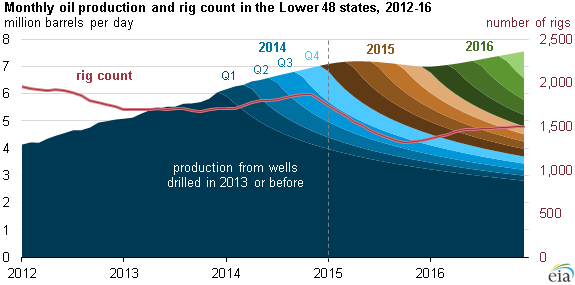
Should its price forecast be realized, EIA projects that the number of operating rigs will decrease by approximately 24% from January to October 2015 before beginning to rebound in November 2015. However, the outlook for Lower 48 production reflects more than just the rig count. Other key factors include the efficiency of drilling, which EIA tracks in its Drilling Productivity Report, the rate of decline in production from existing wells, and changes in the amount of time between the start of drilling (called spudding) and the completion of the well.

6. Falling crude prices will leave oilfield services companies ‘parked,’ may trigger layoffs
CALGARY – Depressed oil prices will cause many producers to drill, but not draw from, new wells, with the result that oilfield service companies will suffer from the drop in activity, the head of the Petroleum Services Association of Canada said Tuesday
PSAC is now predicting 7,650 new wells will be drilled in Canada this year, which would mark a 32% drop from the 11,226 wells drilled in 2014.

7. China to keep 200 MMbbl crude hoard even if oil rallies
BEIJING (Bloomberg) -- China is poised to maintain its commercial hoard of more than 200 MMbbl of crude within three years even if oil rallies toward $130/bbl.
In terms of capacity, China can store 307 MMbbl of commercial oil inventory as of last year, CNPC said in its annual research report also published on Jan. 28. Strategic oil storage tanks, spread over six bases nationwide, can take a further 141 MMbbl, the company said.

8. Cease Fire? The Energy Report 1/28/15
Is OPEC getting ready to declare a cease fire in the oil production wars? OPEC Secretary-General Abdullah al-Badri said that a bottom in oil may be near and high level rumors of meetings between OPEC and Non-OPEC members are creating speculation that there may be some type of agreement in the works to curtail production. Even Saudi Aramco said it would postpone some projects as it appears low oil prices are even making some Saudi expansion unprofitable. While there have been many denials the talk has been making the rounds and it offered oil some support aided by the weakened dollar. Yet with U.S. oil supply rising over 12 million barrels yesterday according to the American Petroleum Institute and rising Iraqi production it is unclear as to how they can structure a cut that will make a difference in the growing global oil glut.
Today is a key day for oil! If oil is going to have a chance to bottom it will have to surge off record U.S. supply and the Fed statement. While there is no press conference most believe the Fed will keep their thoughts behind closed doors and not change the statement. In the meantime traders will look at the Gasoline demand numbers as well as refinery runs to see if there is any changes that might signal  are close to a bottom. $44 is the line in the sand for West Texas Intermediate.

9. Oil Prices: What’s Behind the Drop? Simple Economics
United States domestic production has nearly doubled over the last six years, pushing out oil imports that need to find another home. Saudi, Nigerian and Algerian oil that once found a home in the United States is suddenly competing for Asian markets, and the producers are forced to drop prices.

On the demand side, the economies of Europe and developing countries are weakening and vehicles are becoming more energy-efficient. So demand for fuel is lagging a bit.

Households will likely spend $750 less on gas this year because of the oil prices, the United States Energy Information Administration said Tuesday. Europeans and consumers around the world will enjoy similar benefits.

Finally, #10, from January 20th ...
5 Reasons This Crude Move is Unbelievable
It’s been one amazing sell off in Crude Oil; so amazing we can’t stop writing about it. We’ve covered the long term picture of CrudeThe Best Tweets from Crude’s DropHow to Play a Bounce , andeveryone else’s  articles on crude. But we can’t stop staring at it… We’re the commodity focused moth to the proverbial flame.
But why is this sell off so amazing? What’s special about it?

Friday, March 7, 2014

A Funny Thing Happened on the Way to the Gold Rally

Here is the original version of my story which ran in FreeMarketCafe.com's Daily Grind today.

I’m writing from the Pessimists and Downers Association of Canada – excuse me, the Prospectors and Developers Association of Canada (PDAC), the world’s biggest mining conference. Never before have I been in a group of people sitting on literal gold mines and yet so down in the mouth at the same time.

In a way, we can’t blame them. The action in gold mining stocks played out as absolute carnage for nearly three years. And it seemed every time the miners stuck their heads out of their holes to sniff the air, they’d get whacked on the heads with a stick. Being the mole in a game of Whack-a-Mole will make anybody bitter and jumpy.

Finally, gold and gold miners have started to rally. Gold is up 12% so far this year… and the Market Vectors Gold Miners ETF of gold stocks is up twice as much! But you wouldn’t know the good news from the mood at PDAC.

As I walk through the PDAC this year, held in Toronto, which is deep in winter’s icy grip, I find it fitting that the standard uniform for Canadian business is a black suit with a black overcoat. Many (not all) of these guys are acting like they’re in mourning for something… maybe for the better days of Canadian mining.

And it’s not just a mood, it’s statistical.   Jeffrey Christian of CPM Group pointed out that a third of the gold project development that was scheduled in the early part of 2013 has now been deferred.


Source: CPM Group/Jeffrey Christian

 And if you’re wondering about silver projects, we’re seeing the same thing in that space. Low prices for too long means one project after another has been shelved.

That’s pessimism.

Well I have news for the mourners in black overcoats: better days lie ahead. And I believe they’re coming sooner than you think.

I mean the thing about miners, engineers and geologists is that they hate to sit idle. So as the prices of gold and silver came down, mining companies cut costs to the bone. They redesigned their projects and turned over every rock to find a dollar. Sure, some companies went belly-up. But that just meant that other companies got to pick up great projects for a song.

So we have low-cost miners and developers that picked up projects on the cheap, run by guys who know how to squeeze a dollar until it screams. The best ones not only are going to make money, they’re going to make a LOT of money. All they need is for the price of gold to go up… some.

It looks like they’re starting to get their wish. Gold has rallied sharply since mid-December. And look at the effect that rally has had on junior miners, as tracked by the Market Vectors Junior Gold Miners ETF (NYSE: GDXJ)…
You can see that junior miners finally broke out of their kamikaze dive. And they’re rallying on bigger-than-usual volume. That sure looks like a turn in sentiment to me.

Someone who definitely understands the positive reality underlying all the doom and gloom is Rick Rule, chairman of Sprott U.S. Holdings.

“Bear markets are like sales,” Mr. Rule told a packed room at PDAC. And since junior miners as a group were down 75% from their peaks, it was like “the market is 75% less risky.”

“You’ve been here through the pain,” Mr. Rule added. “Why not stick around for the gain?”

Now, I should say that both Rick Rule and Jeffrey Christian believe we’ll see lower gold prices before we see higher gold prices. Maybe they’re right.

On the other hand, I’m finding a nice collection of miners who make money at current gold prices… and will make a heck of a lot more money at higher gold prices. 

After all, you've got miners producing rocks like this ...


That’s me with an ore sample from a little-known miner.  See all that yellow in the rock? That’s gold.  This is a company mining big, thick visible gold.  And that’s just one target – they have other targets close by.  Don’t tell me they can’t make money – they ARE making money. And yet, because this company is in an industry that is hated (for the time being), this stock is trading for pennies. For the time being.

Maybe prices will go a bit lower. But I don’t think investors should worry too much about catching the exact bottom. There’s just too much potential upside to risk missing the move.

After all, the Chinese are buying gold hand over fist. The world’s central banks keep accumulating gold, even as they pooh-pooh it for the general public. India is likely to lift its restrictions on gold imports sooner rather than later, unleashing a flood of pent-up demand. And ETFs are buying gold again and it was ETF selling last year that hammered gold prices into the pit.

So to my gloomy friends in Canada, I’ll put it in terms you can understand. In the words of the great Canadian rock band Barenaked Ladies:

“Odds are we’re gonna be alright.

Sure things go wrong, but I’ll take my chances

Odds are long, so why not play?”

I’m coming back from Canada with new recommendations for my subscribers. If the market is 75% de-risked, as Rick Rule says, and I agree with him on that, then I’d say the odds are these stocks are going to do all right.

In fact, I’d say the bigger risk is doing nothing. Sitting on your hands could cost you a lot of money.

Sure, things go wrong. But I’ll take my chances.

Whatever you do, good luck and good trades,

Sean Brodrick

Friday, January 3, 2014

Interview With Pengrowth Energy

Here's the latest of my interviews from San Francisco. I talk to Wassem Khalil from Pengrowth Energy.

They have a new project starting up, and other good news.

Thursday, January 2, 2014

Canadian Oil Sands Interview

Canadian Oil Sands (COSWF on the Nasdaq) is a HUGE oil producer.  There are some very interesting differences between this company and other Canadian oil producers.  Those differences may work to Canadian Oil Sands' advantage.

Take a look at this video interview I did in San Francisco in December and decide for yourself ...

Watching the video, you'll see Siren Fisekci (Cool first name, it's pronounced "SEE-ren"; she's of Turkish heritage, apparently) correct me on something I say about the company.  One reason I do these videos is to learn new things about these companies. I hope you learn a few new things, too.

This video is not an immediate endorsement.  If you like this video, come back and see the rest of the interviews I recorded at the San Francisco conference.

Interview with Spyglass Resources

While I was in San Francisco in early December, I sat down for an interview with Spyglass Resources (symbol SGLRF on the OTC, SGL on the TSX).  I'd heard this company's story and was really interested in finding out more.  Click through, and I think you'll find it interesting, too. His comments on pricing of Canadian oil alone is worth your time.


So the team that built Provident Energy Trust is now running this new company, which has long-term assets and pays a high dividend. It's very new, so be aware of that. Dividend investors often look for a long history of dividend payments; Spyglass doesn't have one because it's so new.

Do your own due diligence before buying anything. This interview is not an immediate endorsement. If you like this interview, stay tuned, because I have a lot more coming with a bunch of different companies.

If you want to see the first interview in this series, Vermilion Energy, click HERE.
IF you want to see the second interview in this series, Couer Mining, click HERE.

Sunday, November 17, 2013

The Cariboo Gold Rush: Grub High, Whiskey Bad, Money Plenty!

Gold rushes in Canada have all the exciting elements of one of the old pulp action-adventure novel.  Greed, bloodlust, native Americans, Chinese prospectors! For example, let's look at the Cariboo Gold Rush.


Panning for Cariboo Gold
When I say "Cariboo Gold Rush," you may say "What?"  Most people have forgotten what was the most exciting event of its day. The Cariboo was sandwiched between the California Gold Rush of 49 and the Klondike Gold Rush of 89.

The Native Americans knew about the gold long before the White Man, of course. Heck, it was scattered around for the taking, and when it was buried, they could dig it out with iron spoons. But then some white men found gold on a sandbank in the Fraser River in the 1850s, and the race for gold in British Columbia began in earnest.

The Hudson Bay company first found the gold and succeeded at keeping it quiet for a while. Then Hudson Bay sent 800 ounces to San Francisco to be assayed. Whoops! San Francisco, in that day, along with being a den of villainy, drunkenness and riff-raff, was filled with idle miners who had either blown their fortunes from the 49 gold rush or never found one. At news of the yellow metal, 25,000 men set out from San Francisco for the wilds of British Columbia.

Even before they got there, trouble broke out. The story goes that Indians came into a gold camp under a flag of truce and then slaughtered the unsuspecting miners while their backs were turned. Modern-day historians doubt it was that cut-and-dried. But true or not, one thing the story provided was an excuse to kill the Native Americans who lived on ground the miners wanted to mine. Greed, blood and gold have intertwined throughout history; British Columbia would prove to be no different.

Big Winners and Bigger Losers

On the miners came. More gold was found at a place called Cariboo — even richer than the first strike at Fraser. 

The gold rush started paying off big-time in the summer of 1861.One company estimated that they had made a profit of $80,000 by early August -- this was when gold fetched $18.93 per ounce. A day's worth of work was not measured in ounces of gold -- it was measured in POUNDS of gold.

Some prospecting teams produced up to 30 pounds of gold a day. By the end of the 1861 mining season, $2,600,000 worth of gold had been produced, most of it from the Cariboo region. The output for the next year, 1862, was slightly more.

Thousands of men lined the rivers, panning for gold, and digging up every hopeful inch with wild abandon.

Miners sent letters home to friends, like this one: 

"Dear Joe,
I am well, and so are the rest of the boys. I avail myself of the present opportunity to write you a half dozen lines to let you know I am well, and doing well - making from two to three thousand dollars a day! Times good - grub high - whiskey bad - money plenty.
Yours truly,
Wm. Cunningham"

Such letters spread the word about the gold diggings and the money to be made.

And sure, fortunes were made ... and usually lost. Sometimes they were lost with real style. Big winners who became losers include Billy Barker, Michael Costin Brown and John “Cariboo” Cameron.


"Cariboo" Cameron
 Barker pulled $1,000 worth of gold out of one small crevice he found 80 feet down in a hole that other miners ridiculed. That shut up the doubters right quick.

 Cariboo Cameron gets my vote for the most amazing mix of good and bad luck. He had already made a good strike in the California gold rush with his two brothers. They then heard about the strike on the Fraser River, went north and hit it big again, returning with $20,000 between them, a sizeable sum.

John Cameron then married a beautiful woman, Margaret Sophia Groves, and she had a baby daughter just in time to take her to Cariboo, where Cameron wanted to try his luck.

The baby died on the trip.


Sophia Cameron
Pickled in a Tin Coffin

Meanwhile, Cameron bought $2,000 worth of candles and sold them for $10,000 in the mine fields. That was a surer profit than he could have probably made with gold itself, and a reminder that you can do just as well in pick-and-shovel makers than gold miners, (something Ill be sure to include in my Gold & Resource Trader).

A bitterly cold winter set in. Sophia had another baby, who arrived in the world stillborn. Then Sophia died as well. Cameron became obsessed with the mine, working at it night and day. And sure enough, he struck paydirt.

Cameron was rich, but he was also heartbroken. He wanted to take his wife home for burial, so he hired miners to work three shifts, 24/7 to get the gold out soon as possible. Then he took Sophia home, pickled, in a tin coffin.

The story doesn't end there. Cameron invested his money in everything from steamships to timber, and lost it all. He married a new wife, came back to the gold fields, and met with no success at all. He died flat-broke.

Enter China

Other people were having luck in the gold fields, including the Chinese prospectors.

Yes, even back in the 1850s, the Chinese were hot on the trail of Canadian resources. By 1863, there were some 4,000 in the Cariboo region. They were only allowed to work areas abandoned by the white miners.

But surprising their detractors, Chinese miners were both more disciplined and persistent. They invented the panning machines used to separate gold from mud. And they had some big strikes, even in the abandoned mines. It turns out that the good ol boys just werent looking hard enough.

Chinatown in Barkerville was a huddle of small shacks warmed by wood stoves. There was also a laundry and at least one gambling den. The Chinese men -- and a few women and children -- were used to farming, so they raised pigs and chickens and grew vegetables in their backyards. Along with mining, the Chinese also worked as doctors, herbalists, storekeepers, innkeepers, cooks and restaurant owners.

Welcome to the Boom Town

By the end of 1863, more than 100 companies had staked a total of 3,000 claims, and the value of the gold removed that year was just under $4,000,000.

The years 1864 and 1865 saw similar gold production levels. Most of the gold was found during the first five years of the Cariboo gold rush. Still, many claims were worked until 1900. It is estimated that William's Creek and two of its tributaries, Conklin and Stout's Gulch, produced $30,000,000 worth of gold between 1861 and 1898. 

All Good Things Must End

Gold Rushes always end in a bust. In 1868, the town of Barkerville burned to the ground in what became known as the Barkerville fire. Though reconstruction began the next day, the Gold Rush was already dwindling.

The Cariboo petered out, but the death knell came in an act that had its seeds in 1867; when Russia sold Alaska to the U.S. In 1896, settlers in Alaska found that you could dig up amazing quantities of gold right on the beach.  Those miners that were left in the Cariboo picked up stakes and headed for Alaska. 

Canada hosted other gold rushes -- and an amazing silver rush that I'll have to tell you about as well. But that story, as well as the story of the Klondike Gold Rush, will wait for another time.

4 Lessons from the Cariboo Gold Rush

There are several key lessons to learn from the past:

Lesson #1. Greed may lead you to riches. But keeping them is another matter entirely. For that you need prudent management and financial planning.

Lesson #2. Discipline often separates winners from losers. A disciplined, scientific approach to investing, carefully removing the wheat from the chaff, is equally important.

Lesson #3. There's plenty of ways to make money in a resource boom. You don’t always have to invest in the companies that extract the gold, the oil or other natural resources from the ground. You can do equally well with those that service the industry.

Lesson #4. Booms are often followed by busts. British Columbia sank into an economic depression once the gold ran out.

I think there is plenty of money to be made in gold and other metals right now.  In fact, I'll have new picks for my Gold & Resource Trader subscribers very soon. Good luck and good trades this next week,

Sean

Wednesday, November 6, 2013

7 Hot Stories and 5 Sizzling Charts for Wednesday

Here is some of what I'm reading ...

1. GOLD UPDATE: Holdings in Gold-backed ETP’s fell 0.3 metric tons to 1,875 tons on Monday, dropping to the lowest since April, 2010, according to data compiled by Bloomberg. On the bullish side, sales of gold at the Perth Mint are shifting into higher gear. And the premium (above regular cost) in India has soared to $100 per ounce of gold.

This is due to the Indian government import suppression scheme, of course. I bet there are a bunch of ticked-off people in India right now (smugglers excepted).

2. CHINA AND GOLD. And as for China, its imports through Hong Kong dropped in September from August, but are still up significantly for the year. Here are two charts to drive that home ...


In September Hong Kong net gold import was 52 metric tonnes, down from 142 tonnes in August. That's down 63% m/m. The year-to-date net import is 489 tonnes. Hong Kong gross gold import year to date is 1751 tonnes, gross export 1262 tonnes.


Source 

Annualized mainland net import through Hong Kong is 1101 metric tonnes, a surge of 109% as total import in 2012 was 525 tonnes.  And we aren't even counting the imports through Shanghai.

3. FALLING PRICES. Gas and food prices hit their lowest levels of the year ... 


I wrote more about this topic on Monday. I was at a conference this weekend and one of the speakers was talking about rising gas prices. Along with directly contradicting me, it was just plain wrong.

Anyway, I was pretty positive just two weeks ago that this would boost consumer spending.  I still believe so, but you also have to take into account that millions of people just had their food stamps cut, so that will lessen some of the effect.

4. US DOLLAR I posted a chart yesterday about a possible continued rally in the dollar. Here is more on the topic from Bloomberg. And the always-awesome Kathy Lien adds her two cents

5. ENERGY PRICES (CANADIAN EDITION) Alberta and British Columbia have worked out a deal to move energy resources (produced in Alberta) through BC to new markets. There are hopes that this will ease the $40 discount that Western Canadian Select, the benchmark price for Canadian oil, trades at compared to US oil benchmark West Texas Intermediate.

I'd say that will happen longer-term, but I don't expect much relief in 2014. Still, we'll see.

6. ENERGY PRICES (EUROPE EDITION). Europe's push for cleaner energy is driving up prices (somewhat expected) and holding back the economy (oops!). Once again, America is saved by its abundance of cheap natural gas.


Electricity costs in Europe have spiked 17% for homeowners and 21% for industry. Will this move Europe to re-open mothballed coal plants? Stay tuned.

7. FERTILIZER BREAKTHROUGH?  Multiple people have called me up to tell me about a looming phosphorus (fertilizer) crisis.  Coincidentally, they also are promoting the stocks of phosphorus miners or developers.  Is there a simple solution? This TED speaker thinks so: mycorrhizal fungi. I'm wary because I remember when algae was touted as the next great source of oil. Remember that horse-hockey? Anyway, we'll see.

Wednesday, October 9, 2013

Eagle Hill Exploration

In a previous post, I said I'd move on to more profitable areas of the market -- and I will -- but I just attended a presentation by a junior explorerco and I thought I'd share it.

Reminder: Just because I talk about a company is not an endorsement. I really started this blog as a way for me to think things out.


Anyway, I went to a presentation by Eagle Hill Exploration yesterday. They're working on a project in the Abitibi Gold Belt, in Quebec, a spot on the map called Windfall Lake. Sure it's remote. Way remote. The thing about this project is the grade ...


  • Indicated resource is 538,000 ounces grading at 10.05 grams per tonne of gold
  • Inferred resource of 822,000 ounces grading at 8.76 grams per tonne of gold.

Some of the individual holes are quite extraordinary, including 12.4 meters grading 288.5 g/t gold. That's practically hip-hop-grill grade.

The IR rep making the presentation says that this high grade puts Windfall Lake in the top 7% (in terms of grade) of development-stage gold projects worldwide.

Eagle Hill is one of those stories where somebody ran out of money and another company picked it up for cheap. The purchasing company is Southern Arc Minerals, which has a deposit in Indonesia.

Do you want to invest in Indonesian mining right now? Neither does anyone else. Southern Arc was trading for less than cash, so it used its cash to leverage into 26% ownership of Eagle Hill in August.  Dundee Corporation owns another 26%.

Anyway, Southern Arc fired everybody at Eagle Hill except the chief geologist, who has worked in this area for years.  And they're keeping him busy with a 25,000 meter drill program that should be completed by the end of this year.

Eagle Hill expects to put out an updated resource estimate in early 2014 that will incorporate 55,000 meters of drilling.

And longer-term the company hopes to have a resource of 2 million ounces by the end of NEXT year.

The gold is contained in a pyrite sulphide system. Gold is found around grains of pyrite (fools' gold), in the cracks, or as free grains. This makes the core samples look very shiny indeed. 


OOOH! AHHHH!
Now, the property is accessible by logging roads. Still, it's remote enough that the crew lives onsite at a camp. If and when this ever becomes a mine, they'll have to string in a 100-kilometer (62-mile) power line.  The company ballpark estimates that as costing $1 million per kilometer. Since mining companies are staffed by optimists, let's say $1.5 million per kilometer for the power line, or a nice round $150 million for the whole electrified spaghetti string.

Still, not only is the grade at the deposit high-grade, the metallurgy is very friendly indeed. Preliminary tests have shown 91.7% gold recovery using simple gravity, flotation circuit and cyanide.

For this reason, the company reckons that building the project would cost in the LOW hundreds of millions of dollars, not a billion dollars.

Of course, it's a long way to a preliminary economic assessment, pre-feasibility study, bankable feasibility study, you name it. Let's not get ahead of ourselves.

Problems and Hurdles

So far, I've painted a nice picture of the project. Here are some things that concern me ...


  • There are 493,383,396 fully diluted shares outstanding.  Obviously, there needs to be some 4-to-1 or 5-to-1 rollback or reverse split. Anticipation of this rollback is obviously weighing on the share price, or should be.  So, the sooner that is done, the better.
  • The company is projecting that Windfall Lake will be an underground mine. That brings with it a host of potential complications, not least of which is that part of Canada is known for its underground rivers. 
  • The company needs money. It raised $12 million in a private placement, but after paying off debts and funding its current drill program, it is down to "about" $1 million in the bank.


If I owned the company, I'd be doing a 5-for-1 rollback followed by a private placement. But that's me.

Management says they're open to all sorts of possibilities -- selling the project, developing it, and so on. I think the obvious goal for them would be to drill and drill until they build up that resource AND show blue-sky potential, then sell it to one of the majors.

But will the majors be in a buying mood? I've stood on perfectly good projects right next door to major miners, while the guy running it dropped elephant-sized hints that he was in talks with "interested parties."  You know what those elephant-sized hints are worth in the real world? A bunch of bull-elephant-sized fertilizer.

That's not to say that Windfall Lake doesn't have potential. Of course it does. And the management is not dropping any hints, or doing anything that would make me roll my eyes.  They seem to be seizing on an opportunity, now let's see if they can make something of it.

Eagle Hill is going on my watch list. But that's as far as it goes now. 

Eagle Hill will be presenting at the Mineral Exploration Roundup in Vancouver in January of next year.  We'll see if that helps the stock.

What do you think?